
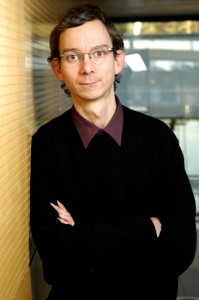
Prof. David Guiraud
INRIA research scientist, leader of DEMAR team
Montpellier, France
Title: From theory to clinical use, a long pathway
Abstract: Neuroprostheses (NP) have now been used for few decades. Beginning with pacemakers we are now close to restore some artificial vision with retina neuroprotheses. However when looking at NP used for movement restoration, even though they were studied quite earlier from the sixties, they are still very few which provides some benefits to the patient and even less that went through a widespread commercial use. After an overview of state of the art concerning tentative of movement restoration, some advanced researches will be presented that sustains new hope. It will provide a way to understand that restoring movement is complex at all the level of the design and use. From the basics of movement generation and control based on modeling to complex control and thus technology to provide multiple muscles contractions in a safe, reliable and accurate way, together with a low level of fatigue.
Short CV:
He obtained is master and engineering degree from Ecole Centrale de Paris. He founded DEMAR team at INRIA Sophia-Antipolis Méditerranée and LIRMM in 2004.
For more than 10 years he was involved in projects and teams working on rehabilitation based on FES (Functional Electrical Stimulation). The main areas of interest concern: 1) modeling of sensory motor system, in particular the striated muscle, 2) designing advanced implantable neuroprostheses to restore motor functions. Apart from this theoretical work, David Guiraud was regularly involved in clinical research activities in close relationship with surgeons and physiotherapists. This leads to the definition of rehabilitation protocols but also applied clinical research activities such as quiet standing for paraplegia, fatigue assessment, movement synthesis and control.
To restore more complex sensory and motor functions such as movement, David Guiraud currently works on the development of neuroprostheses that may provide for complex stimulus shapes and may drive multipolar electrodes. They have also to spread over multiple target sites so that he proposed an implanted network of neuroprostheses.
Simulation, movement synthesis and control, signal processing can support the research developments and can help to evaluate the effect of neuroprostheses through objective and quantitative evaluation. At the beginning of his career David Guiraud worked a lot with AIMD (Active Implantable Medical Devices) industry so that he is still advisor for such companies and provides for scientific and technical advices.